Vasoryn Ingredients –
The Cardiovascular Science
Behind Every Component
A complete ingredient-by-ingredient breakdown of Vasoryn's endothelial intelligence formula. Each section covers what the ingredient is, what documented role it plays in the cardiovascular nitric oxide system, what published research at PubMed and NIH ODS says about it, and precisely why it was included in the Vasoryn formula. Full research references throughout.
Two Tiers. Eight Ingredients.
One Endothelial System.
Tier 1 — Individually Disclosed Micronutrients: Niacin (20mg, 125% DV) and Zinc (11mg, 100% DV) are each named with specific milligram amounts and percent Daily Value figures on Vasoryn's Supplement Facts panel. This transparency is the first quality signal — it allows independent verification that these essential nutrients are present at meaningful amounts.
Tier 2 — 570mg Proprietary Blend: L-Citrulline, L-Carnitine, Pine Bark Extract, Maca Root Extract, Grape Skin Extract and Saffron Stigmas Extract are combined in a 570mg total blend with no individual amounts disclosed. Under FDA labelling regulations, ingredients must appear in descending weight order, so L-Citrulline's first position indicates it is the largest component by weight — consistent with its role as the primary NO precursor. The NIH Office of Dietary Supplements identifies label transparency and GMP certification as the primary quality evaluation criteria for dietary supplements. See the Vasoryn endothelial intelligence approach or user reviews.
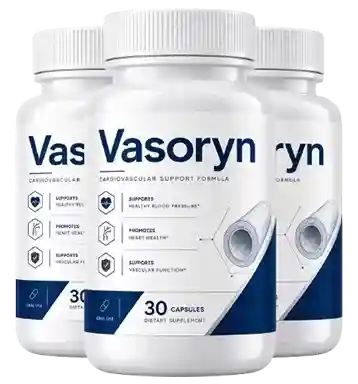
All 8 Vasoryn Ingredients
With Research References
Niacin is Vasoryn's most transparently disclosed ingredient — 20mg per capsule (125% DV) individually named with its percent Daily Value on the Supplement Facts label.
Niacin (vitamin B3) serves as the direct biological precursor to NAD+ (nicotinamide adenine dinucleotide) and NADP+ — universal cellular coenzymes involved in over 400 metabolic reactions. In the cardiovascular context, NAD+ availability is essential for endothelial cell energy metabolism, mitochondrial function, and the sirtuin pathway (particularly SIRT1 and SIRT3) that regulates eNOS activity, antioxidant defence, and endothelial cell stress resistance. While Vasoryn's 20mg niacin is a nutritional-range dose rather than a pharmacological one, it provides the vitamin B3 foundation that the rest of the formula depends on for cellular metabolic function. Research: NIH ODS – Niacin.
Niacin supplies the NAD+ precursor that fuels the metabolic pathways endothelial cells use to produce and regulate nitric oxide — the cellular energetic foundation on which L-Citrulline's substrate, Pine Bark's eNOS stimulation, and Grape Skin's eNOS expression all depend.
Zinc is Vasoryn's second individually disclosed nutrient — 11mg at 100% Daily Value, providing complete mineral Daily Value coverage in one daily capsule.
Zinc is an essential trace mineral that cofactors copper-zinc superoxide dismutase (CuZn-SOD) — the primary antioxidant enzyme in endothelial cells and erythrocytes. CuZn-SOD catalyses the conversion of superoxide anion (O₂⁻) to hydrogen peroxide and oxygen, neutralising the most abundant reactive oxygen species produced in vascular tissue. Superoxide's relevance to Vasoryn's formula is direct: superoxide reacts with nitric oxide at near-diffusion-limited rates, producing peroxynitrite (ONOO⁻) — a potent oxidant that destroys NO before it can relax vascular smooth muscle. By supporting CuZn-SOD antioxidant activity, Zinc acts as a NO preservation mechanism — protecting the NO that L-Citrulline, Pine Bark, and Grape Skin resveratrol help the endothelium produce. Research: NIH ODS – Zinc.
Zinc is the NO preservation layer — the antioxidant mineral that ensures the nitric oxide produced by L-Citrulline substrate and eNOS stimulation from Pine Bark and Grape Skin actually reaches vascular smooth muscle rather than being destroyed by superoxide en route.
L-Citrulline is the primary active ingredient in Vasoryn's endothelial intelligence formula — the nitric oxide precursor that forms the substrate foundation of the triple eNOS architecture.
L-Citrulline is an alpha-amino acid produced in the small intestine and found in watermelon. Its cardiovascular pharmacokinetics make it more effective as an oral NO precursor than direct L-arginine supplementation: ingested L-Citrulline is absorbed in the small intestine largely intact (unlike L-arginine, which is substantially degraded by intestinal and hepatic arginase) and converted in the proximal renal tubules to L-arginine by argininosuccinate synthetase and lyase. This conversion dramatically raises plasma L-arginine more effectively and for longer duration than equivalent doses of L-arginine itself — a finding replicated across multiple pharmacokinetic studies.
Once L-arginine reaches endothelial cells, endothelial nitric oxide synthase (eNOS) converts it to nitric oxide and L-citrulline, recycling the substrate in the citrulline-NO cycle. NO diffuses into surrounding smooth muscle, activates soluble guanylate cyclase, produces cyclic GMP, and triggers smooth muscle relaxation — vasodilation. Published human research on L-Citrulline including randomised controlled trials examining blood pressure and arterial stiffness outcomes is indexed at PubMed.
L-Citrulline is the NO substrate layer — the first and most foundational point in Vasoryn's triple eNOS architecture, providing the L-arginine pool that eNOS converts to the nitric oxide on which all of Vasoryn's vascular function and blood pressure support ultimately depends.
L-Carnitine addresses the cardiac energy dimension of Vasoryn's formula — the mitochondrial fatty acid transport that heart muscle cells depend on for continuous energy production.
L-Carnitine (trimethylaminobutyric acid) is synthesised from lysine and methionine in the liver and kidneys and is present in high concentrations in cardiac and skeletal muscle. Its primary cardiovascular role is the transport of long-chain fatty acyl-CoA across the inner mitochondrial membrane via the carnitine shuttle system — specifically through the action of carnitine palmitoyltransferase 1 (CPT1) and CPT2. Without adequate carnitine, long-chain fatty acids cannot efficiently enter the mitochondrial matrix for beta-oxidation, the primary energy-producing pathway in cardiac tissue.
Heart muscle operates at continuous high metabolic demand — unlike skeletal muscle, which is intermittently active, the myocardium never rests. This makes the carnitine-dependent fatty acid transport pathway particularly critical for cardiac function and explains why L-Carnitine is studied extensively in cardiac metabolism research. Published research indexed at PubMed documents L-Carnitine's roles in cardiac metabolic function.
While L-Citrulline, Pine Bark and Grape Skin address the vascular tone and NO pathway dimension of Vasoryn's formula, L-Carnitine specifically addresses the heart muscle's energy supply — completing the "heart health" claim with a mechanism distinct from the blood pressure and vascular function pathway.
Pine Bark Extract is the second point of Vasoryn's triple eNOS architecture — the botanical that stimulates eNOS enzyme activity independently of substrate availability, amplifying the NO output from the L-Citrulline substrate layer.
Pinus pinaster maritime pine bark extract is standardised for oligomeric procyanidins — a class of flavonoid polyphenol with documented cardiovascular and endothelial activity. The primary eNOS mechanism involves procyanidin-driven phosphorylation of eNOS at Ser1177 (the activating phosphorylation site), which increases enzyme catalytic activity — meaning more NO is produced per unit of L-arginine substrate available. This is distinct from and additive to L-Citrulline's substrate mechanism: L-Citrulline provides more fuel; Pine Bark makes the engine burn it more efficiently.
Pine Bark Extract additionally acts as a superoxide scavenger via direct antioxidant activity, protecting the NO produced from oxidative destruction alongside Zinc's CuZn-SOD pathway. A comprehensive review indexed at NIH PMC summarises human research on Pine Bark Extract for endothelial function, blood pressure and vascular outcomes.
Pine Bark Extract is the eNOS enzyme activity layer — it makes Vasoryn's eNOS more productive with the L-arginine that L-Citrulline supplies, while simultaneously contributing antioxidant NO protection alongside Zinc's CuZn-SOD mechanism.
Maca Root Extract is Vasoryn's adaptogenic support layer — addressing the cortisol-cardiovascular axis dimension that direct NO pathway ingredients alone cannot reach.
Lepidium meyenii (maca) is an Andean root cultivated at 4,000–4,500m altitude in the Andes. Its active compounds — glucosinolates, macamides, macaridine and various alkaloids — have documented adaptogenic activity in published research, particularly regarding HPA (hypothalamic-pituitary-adrenal) axis modulation and energy-related outcomes. The cardiovascular relevance is indirect but significant: chronic HPA axis dysregulation increases catecholamine and cortisol exposure, which downregulates eNOS expression, damages endothelial cells through oxidative stress, and impairs the vascular relaxation capacity that Vasoryn's formula builds. Maca's adaptogenic buffering of this stress-cardiovascular axis protects the endothelial NO system from the most common lifestyle disruptor of vascular health. Research: PubMed.
Maca Root addresses the stress-endothelium connection — protecting the NO pathway that Vasoryn's other ingredients build from the chronic cortisol disruption that is the most common environmental factor degrading endothelial function in modern adults.
Grape Skin Extract is the third and deepest point in Vasoryn's triple eNOS architecture — resveratrol's SIRT1 pathway stimulates eNOS gene expression itself, increasing the amount of eNOS protein endothelial cells produce.
Vitis vinifera grape skin is among the most concentrated natural sources of resveratrol (trans-3,5,4'-trihydroxystilbene), a stilbenoid polyphenol with documented effects on SIRT1 (sirtuin 1) activation. SIRT1 is a NAD+-dependent deacetylase that deacetylates eNOS, preventing its inhibition by calmodulin-dependent protein kinase — and also activates the SIRT1/AMPK pathway that upregulates eNOS gene transcription. The net effect is greater eNOS protein expression in endothelial cells: more eNOS enzyme molecules means more NO production capacity for any given substrate (L-arginine) and enzyme activity (Pine Bark eNOS phosphorylation) input.
Resveratrol's cardiovascular research also documents effects on LDL oxidation inhibition, platelet aggregation, and inflammatory signalling in endothelial cells. Quercetin and other grape skin polyphenols contribute additional antioxidant protection. Published research: PubMed – Resveratrol SIRT1 eNOS.
Grape Skin Extract is the eNOS expression layer — by upregulating eNOS protein production via SIRT1 activation, it increases the endothelium's fundamental NO-producing capacity beyond what substrate (L-Citrulline) and enzyme activity (Pine Bark) improvements alone can achieve.
Saffron Stigmas Extract is the smallest-by-weight component in Vasoryn's blend and the formula's unique bioactive antioxidant finishing layer — delivering crocin, crocetin and safranal, a chemically distinctive group of vascular protective compounds.
Saffron (Crocus sativus) stigmas contain an unusual class of water-soluble carotenoid glycosides — crocins — that are distinct from the fat-soluble carotenoids found in most botanical sources. Crocin (the glycoside) and crocetin (its aglycone) have documented free-radical scavenging antioxidant properties at the cellular level, with research on effects including mitochondrial membrane protection, reduction of oxidative markers in vascular tissue, and mood-supportive properties via serotonergic pathways (particularly relevant for the cortisol-cardiovascular connection). Safranal, saffron's primary aromatic compound, has demonstrated anti-inflammatory properties in published research. The water-soluble nature of crocins means they can access vascular compartments that fat-soluble antioxidants cannot, making Saffron's antioxidant contribution genuinely complementary to the procyanidin (Pine Bark) and polyphenol (Grape Skin) layers. Research: PubMed – Saffron Crocin and NIH NCCIH – Saffron.
Saffron Stigmas Extract completes Vasoryn's antioxidant protection architecture with a water-soluble carotenoid antioxidant class entirely distinct from Pine Bark's procyanidins and Grape Skin's stilbenes, covering vascular compartments the other antioxidants cannot reach.
Full Scientific References — Vasoryn Ingredients Page
- NIH ODS — Niacin (Vitamin B3): NAD+ synthesis, sirtuin pathway and cardiovascular cellular energy
- NIH ODS — Zinc: CuZn-SOD cofactor activity, endothelial antioxidant defence and NO preservation
- PubMed — L-Citrulline: randomised controlled trials on blood pressure and arterial stiffness
- PubMed — L-Citrulline pharmacokinetics: plasma L-arginine elevation vs direct L-arginine supplementation
- PubMed — L-Carnitine: mitochondrial fatty acid transport and cardiac energy metabolism
- NIH PMC — Pine Bark Extract (Pinus pinaster): eNOS phosphorylation, endothelial function and blood pressure
- PubMed — Maca Root: adaptogenic HPA axis modulation and energy-vitality outcomes
- PubMed — Resveratrol SIRT1 activation and eNOS gene expression in vascular endothelium
- PubMed — Saffron crocin/crocetin: water-soluble carotenoid antioxidant and cardiovascular cellular protection
- NIH NCCIH — Saffron: current research summary and safety profile
- PubMed — Zinc and CuZn-SOD: endothelial superoxide scavenging and nitric oxide preservation
Science Verified. Formula Clear.
Ready When You Are.
Every Vasoryn ingredient documented, every research reference live at PubMed and NIH. One daily non-stimulant endothelial intelligence capsule. 60-day guarantee.